You cannot pay ChatGPT or Google to recommend your business. AI assistants name the businesses they can find, read and verify across the open web: your website, your Google Business Profile, your reviews and the other sites that mention you. Here is what to do, in the order that matters.
How do ChatGPT and Google AI choose which businesses to recommend?
They look for businesses that are clearly described on their own site, consistently listed elsewhere, and backed by evidence such as reviews, case studies and mentions on other websites.
When ChatGPT answers a question about local services, it runs a live web search through its own crawler, OAI-SearchBot, and reads the pages it finds. Google's AI Overviews and AI Mode draw on pages already indexed in Google Search, and Google states there are no extra requirements or special files for these features.
Ranking first is no longer enough on its own. Ahrefs reviewed about four million AI Overview citations in March 2026 and found that only 38% of cited pages ranked in the top ten for the same query. The rest came from further down, often because they answered a sub-question better.
Start with a 10-minute test
Before changing anything, find out what the assistants say today. In a private browser window, ask ChatGPT, Google AI Mode, Gemini and Copilot the questions your customers ask, such as "who does emergency roof repairs in Wollongong". Ask each question two or three times, because answers vary. Note whether you are named, which competitors are named, and which websites are cited as sources. Those sources are your target list.
The stakes are rising. BrightLocal's 2026 consumer survey found 45% of consumers now use AI tools for local business recommendations, up from 6% the year before.
Make sure AI can read your website
Check that your robots.txt file and any firewall or content delivery network allow Googlebot and OAI-SearchBot. Blocking OAI-SearchBot removes you from ChatGPT search answers entirely. GPTBot is a separate crawler used for model training, so you can block it while still allowing search.
Keep prices, services, suburbs and FAQs in plain HTML text rather than inside images or content that only loads after JavaScript. No llms.txt file or new markup is required.
Answer customers' questions on your pages
AI assistants quote pages that state the answer plainly. Give every main service its own page, open with a direct two or three sentence answer to the question people actually ask, then add the detail: who it suits, where you work, what it costs, how long it takes, and proof.
A Princeton-led study presented at KDD 2024 found that adding citations, quotations and statistics made pages up to 40% more visible in generative engine answers. Evidence on the page is what gets quoted.
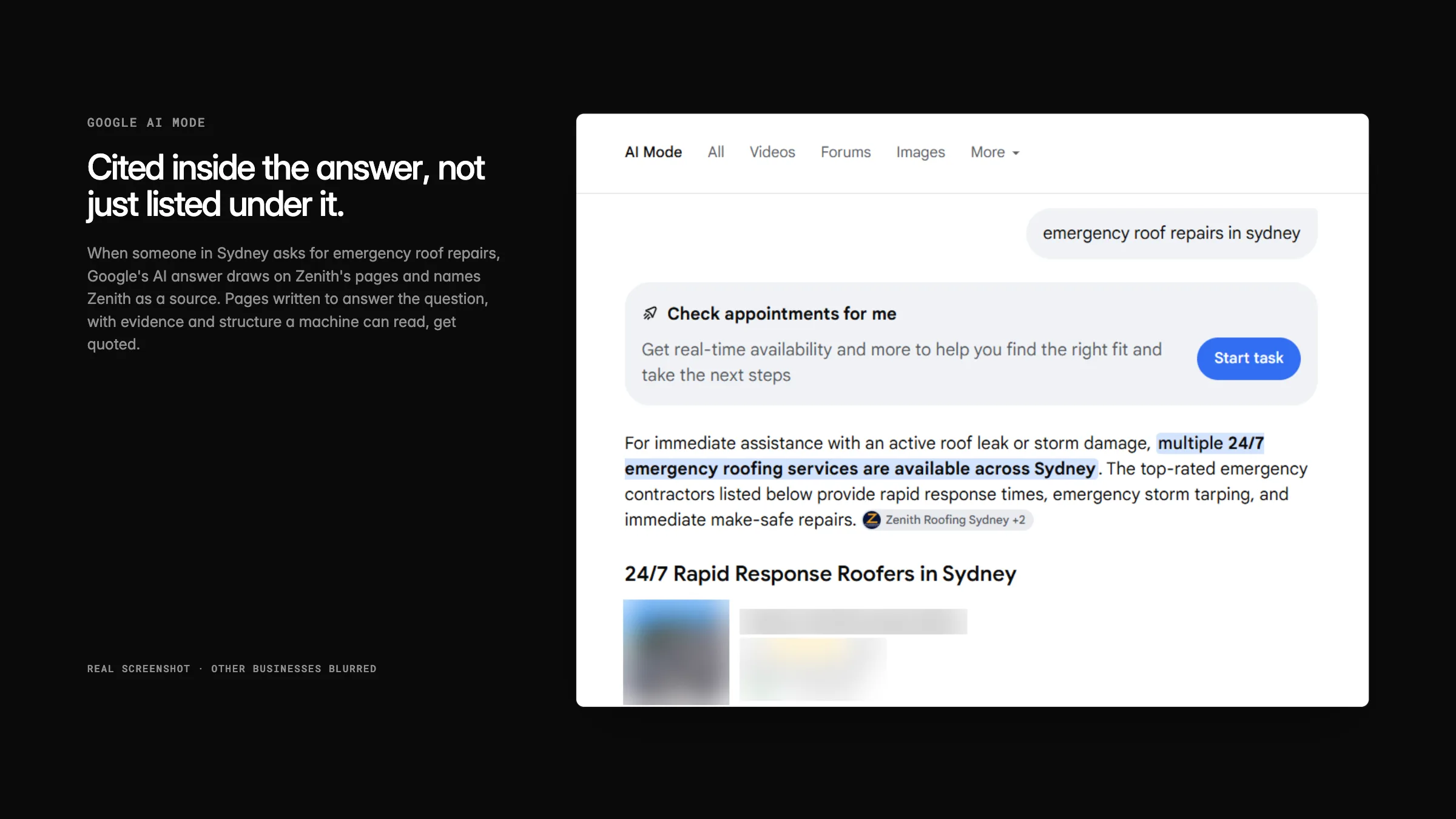
This is how Adcraft's roofing client became a cited source. After its service and suburb pages were rewritten to answer searcher questions directly, with FAQ schema and tracked phone numbers, Google's AI Mode began citing Zenith Roofing for emergency roof repairs in Sydney. The screenshot at the top of this article is that answer. Tracked organic enquiries rose from 7 to 28 over the same six-week window two years apart.
Being the cited source also protects you as clicks fall. Pew Research Center found that when an AI summary appears, users click a traditional result on 8% of visits, compared with 15% without one.
Keep your details identical everywhere
Your business name, address, phone number, services and hours should match on your website, Google Business Profile, Bing Places, Apple Maps and your industry's directories. Mismatches make an assistant less certain who you are, and uncertainty is why it names a competitor instead. Our local SEO guide for the Wollongong map pack covers the profile fields that matter most.
Ask every happy customer for a genuine review and reply to each one. Never write or buy reviews: the ACCC treats fake or selectively edited reviews as misleading conduct under the Australian Consumer Law.
Earn mentions on other websites
ChatGPT leans heavily on third-party pages when it recommends businesses, so a complete website is only half the job. Useful sources include local news, your industry association's member directory, chamber of commerce listings, genuine "best of" articles, supplier case studies and forum threads where you answer questions properly. Each is a page an assistant can read that says the same thing about you as your own site does.
How long does it take?
In our client work, new AI citations usually appear within two to four months of fixing crawler access, rewriting service pages and tidying listings. Nobody can guarantee a mention, because every answer is generated fresh and varies between sessions. Re-run your 10-minute test monthly with the same questions and fix whatever is missing.
Frequently asked questions
Can you pay ChatGPT to recommend your business?
No. OpenAI began testing clearly labelled ads in ChatGPT in 2026, but states that ads do not influence the answers ChatGPT gives and that advertisers cannot shape or rank responses. Google sells ads around AI Overviews, not inside the generated answer. Recommendations are earned through clear pages, consistent listings, genuine reviews and third-party mentions.
Does ChatGPT recommend local businesses in Australia?
Yes. ChatGPT uses the searcher's approximate location and a live web search, so Wollongong, Illawarra or Sydney queries return Australian businesses it can find and verify. Businesses with complete profiles, suburb-specific service pages and recent reviews are named more often. If you are never named, the 10-minute test above usually shows which sources are missing.
Do I need an llms.txt file?
No. Google has said that no AI text files or special markup are needed to appear in AI Overviews or AI Mode, and OpenAI's crawler documentation does not require one. An llms.txt file does no harm, but crawler access, plain-text answers and consistent listings are what get a business recommended.
How do I know if ChatGPT is recommending my business?
Ask it directly, several times, in a private window, using the questions your customers would ask, and record the businesses and sources it names. Most analytics tools under-report AI referrals, so also check your website analytics for traffic from chatgpt.com, perplexity.ai and copilot.microsoft.com, and ask new enquiries how they found you.
Want AI to recommend your business?
Adcraft's AI SEO service in Wollongong starts with a visibility audit: the tests described above, run across each platform, plus a check of crawler access, listings and page structure. It builds on our SEO work for Wollongong businesses, and we report leads by source each month so you can see what the citations are worth.
Written by Aman Hirani, Web Developer and Data Scientist at Adcraft Studio, a marketing agency in Wollongong that helps businesses get found in Google and AI search.


